Search This Blog

Sunday, 10 August 2014

Sandalwood found to have wound healing effects

The implications of a fascinating piece of new research could be widespread: 

Researchers at the Ruhr-Universität Bochum in Germany have found that not only are there olfactory receptors in the top layer of human skin, but have shown that a particular sandalwood odourant can trigger those receptors resulting in increased growth and migration in the surrounding cells.


As this is such new research, there is every chance that other odourants will, in the future, be found to have similar or perhaps quite different effects on the skin with obvious implications for their use in perfumery as well as for medical and other applications.

This research, led by Dr Daniela Busse and Prof Dr Dr Dr med habil Hanns Hatt from the Department for Cellphysiology published their report in the "Journal of Investigative Dermatology”.  


There are many synthetic sandalwood
odourants of which this is one
Reporting of the findings appears in Time but they don’t mention there, the answer to the question that will be uppermost in the minds of perfume-makers: which specific odourant has this effect?

The answer is it was Sandalore (a brand name owned by Givaudan) or 3-methyl-5-(2,2,3-trimethyl-1-cyclopent-3-enyl)pentan-2-ol, if you prefer the chemical designation.

Monday, 4 August 2014

100 years ago today

What was to become known as the First World War started 100 years ago today and while most people are commemorating the anniversary with the now conventional poppies I have something slightly different to offer:

A 1st World War Daffodil
Here is a picture of a humble pressed daffodil in remembrance of my dear grandfather who - in a moment of wild romance - picked it in the midst of battle and sent it home.

I’ll reproduce here the story in memory of one of the heroes who came home, no less to be remembered than those who died in the conflict, no less heroic, but as he described himself in one of his last letters home a “lucky blighter”.  You can read more about him on the website I created in his memory.

I first heard the story of how the daffodil came to be collected and preserved from Poppa (Cyril Bartlett) when I was a young boy. I can remember him clearly telling the story with a great deal of drama and I recall at the time being impressed by it, but not really understanding. 

Years later I would hear the same story in a very different context from Nanny (Jessica Bartlett) – I’ll come to that, what matters for now is that it was the same story. Here it is, as accurately as I can render it: 


One damp spring day, while fighting in the trenches in France, Cyril noticed, out in the distance, in the no-mans-land between his and his enemies’ trenches, a daffodil just coming into flower. He resolved then, that if it were still there that night he would have it to send home. As evening fell, the flower was still there, by now fully open; so Cyril crawled out into no-mans-land [I can see him now making crawling motions with his elbows and giving dramatic emphasis to the need to keep his head right down in case he should be spotted by an enemy sniper]. He reached the flower, picked it, held the stem carefully in his mouth and turned, crawling with equal care back to his own trench. There the flower was carefully pressed and sent home.
The first time I heard this tale; it was a thrilling story of daring from a world of danger that appeared exciting and remote. The second time I heard it (or at least the second that I can remember clearly – I suspect Poppa told us grandchildren the story more than once) it was in the late summer of 1979. I had spent the summer holiday that year helping to nurse Poppa through his final illness and after the funeral I returned to Gayfield to help Nanny sort through his things: it was a difficult time for both of us. The daffodil was stored at that time between the leaves of a book – I had long since forgotten all about it until Nanny showed it to me and re-told the story I’ve related above, though without the dramatic embellishments. By now I was old enough to understand it as a story of deep love and the mad, romantic gesture of commitment and longing that it really was.
Stored with the daffodil, with all the other papers, is a pressed fuchsia, which I believe Jessie sent back to Cyril in a return letter and he retained and brought home from the war. The note you can see in the scan here is written in Cyril's own hand some years after he came home, and after he saw his own sons go off to fight in the Second World War. 

For me those brown and tattered, flattened flowers have always been the most potent symbol of the love between my grandparents that was the backdrop to my childhood.
In remembrance of all those caught up in the terrible tragedy of the Great War whether they came home or not.
A daffodil.


Wednesday, 30 July 2014

Lily of the Valley – mystery, manufacture & murder

Mystery

Perfumery has always glorified the floral and for centuries perfumers have sought ways to extract the essence from real flowers to incorporate into their creations. With many flowers this quest has met with considerable success, with a few commercially viable products produced that are still used in modern perfumery: rose and jasmine being the primary examples. 
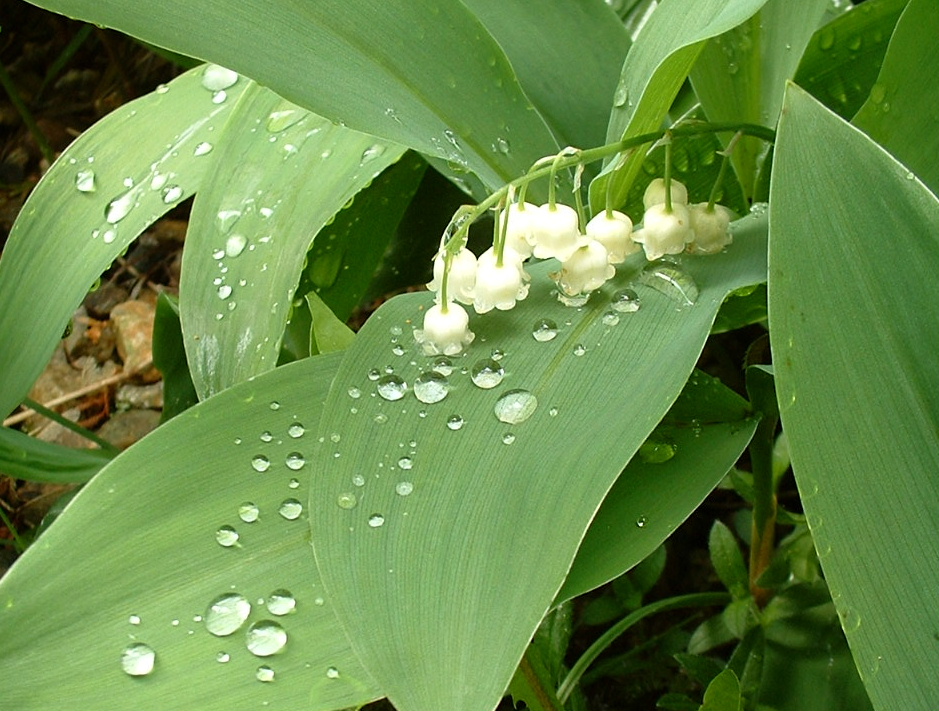
Lily of the Valley - picture courtesy of Wikimedia Commons
One flower that has always eluded extraction is the Lily of the Valley (Convallaria majalis) or Muguet*: distillation yields very little of an unpleasant smelling oil not a bit like the dense, exotic scent of the fresh flowers.  Solvent extraction and even modern CO2 extracts have similarly been completely unable to capture the scent.  This is because the flower produces the scent only at the point of release – none is stored in the flower – so it cannot be extracted.  The flower itself only contains pre-cursor chemicals from which the scent is formed directly into the air.
Diorrissimo - picture from Basenotes
Yet many people will be familiar with the scent of Lily of the Valley, not through smelling the fresh flowers, but from perfumes containing or replicating its scent – perhaps the most famous of these being Diorissimo.  So, if you can’t extract the scent, how is that done?


*Muguet is the French word for Lily of the Valley, a flower popularly used at weddings.  Lily of the valley is a  sweetly scented (and highly poisonous) woodland flowering plant that is native throughout the cool temperate Northern Hemisphere in Asia, Europe and in the southern Appalachian Mountains in the United States.


Manufacture

Here we see how the chemist is the perfumers best friend: a good number of materials have been discovered or created that replicate, at least in part, the scent of these mysterious flowers.  Many people would say that synthetic Lily of the Valley begins with the synthesis in the early part of the 20th Century of Hydroxycitronellal: it’s difficult to be sure exactly when it was first used because the nature of the material was kept a closely guarded secret.  What we do know is that as early as 1906 it was being made by Givaudan and sold under the trade name Laurine. 
Dr E Emmet Reid
Credited with re-discovering Hydroxycitronellal
Image from The Johns Hopkins University
At the outbreak of WWI it was being manufactured in Germany and, as the war meant it ceased to be available, efforts were made to find ways to make it that resulted in it’s being manufactured in an American factory and, during the 20s, it gradually become well-known within the trade.  Most perfumers would agree that, while no one chemical can ever fully represent the scent of a flower, hydroxycitronellal gives a very close facsimile to the aroma of the fresh flowers of Lily of the Valley.  Curiously enough however it does not appear to be present in that, or any other natural flower scent.
I’m presenting in the sections at the end of this post, descriptions of a selection of materials that replicate the scent of Lilly of the Valley, with descriptions of their olfactory properties as well as, in many cases, the restrictions on their use that have led to their decline.  These are mainly for the benefit of DIY perfumers, but may also be of interest to perfumistas curious about ingredients.  I’ve included quite a few quotations from Steffen Arctander’s wonderful descriptions of aroma chemicals – rather less well known than his work on materials of natural origin – but just as good.


Murder

Structure of Lyral - image courtesy Wikimedia Commons
So where does the murder come in?  Well in one case a forthcoming ban by the European Union will, over the next couple of years, result in the certain demise from perfumery altogether of one of those materials.  The material that is being killed off by the regulators is Lyral and although it’s only going to be banned in the EU, that will very likely be reflected in a prohibition by IFRA (the International Fragrance Association) and even if it isn’t all the major perfume manufacturers will phase it out of use completely, so it will effectively vanish from the world.

After the jump you can read detailed descriptions of a range of materials used in connection with Lily of the Valley scents.

Saturday, 19 July 2014

Interview with an Indie Perfumer

The Perfumer’s Organ at Pell Wall
The charming Clare Wood interviewed me at my London hotel a few weeks ago.  We talked about aroma chemicals, natural perfumery materials, the art and science of perfumery, other perfumers I admire and what to do if you’re looking to get started in the business.

You can read the full interview on Basenotes.

Sunday, 11 May 2014

Pell Wall Perfume on ITV This Morning Show

Two fragrances from Pell Wall’s 1953 range, a couple of pieces of ambergris that I keep for demonstration purposes, some synthetic ambergris and some of my ambergris tinctures are featured on this section of the ITV This Morning show from Friday 2nd May.

The whole segment is a bit bonkers, featuring as it does a whole range of things made using poo, but it’s nice to see 1953 Eau de Toilette and 1953 Pour Homme featured (even if they didn’t get the spelling right!)

You need to fast forward to 6 minutes into the show if you want to skip the other products: Perfume is on last.


The bottle of part-made tincture they have a sniff at by the way was extracted from a larger batch that is being made from a piece found by artist and guest-house owner Jac Volbeda on a beach in the Western Isles of Scotland last year that has been tincturing since January: I’ll be blogging in detail about this when it’s finished.


Tuesday, 11 March 2014

Perfume Making Workshop in London

Perfume Making Workshop with the Pell Wall Perfumer

I’m pleased to report that, by popular demand, I will be running another perfume making workshop in London on:
Saturday 31st May
from 11am to 5pm
at The Scent Salon
Les Senteurs:
2 Seymour Place, Marble Arch, London W1H 7NA
(that’s the Wigmore Street end of Seymour Place)

The workshop is aimed at people who have never made a fragrance for themselves before and concludes with a bottle of a fragrance you've created yourself: for those who have made fragrances before, perhaps at one of my earlier workshops, you will of course be able to make something completely new.

The Scent Salon at Les Senteurs
The price is £135 per person, which includes light refreshments, five hours of tuition and practice, all the materials you need, a bottle of your own fragrance to take home and even a glass of fizz at the end.  There will be a break for lunch, which isn't included, at one of the many nearby establishments.

I will provide tuition about materials, guidance on blending and everything you need, all you need to bring is your un-perfumed self.

I'll will take you through the recording of the formula too and as long as you do that carefully you'll be able to order more of the fragrance you've designed from Pell Wall in the future.

I'll also provide odour and use descriptions of each of the 30+ materials we'll be using and these will be both available on paper on the day and sent electronically in advance for those who want to do some pre-work.  I'm also open to requests (in advance) if there is a particular material you want to work with, as long as I have it available and it isn't outrageously expensive then I'm happy to bring some along.

The venue is of course also a specialist perfume shop, so you might like to have a browse while you're there.  The shop is open until 7pm and although the course ends at 5pm, I will stick around to answer questions afterwards too.

Space is limited and places have started to go already so if you are interested, please book quickly to avoid disappointment:


Thursday, 6 February 2014

Pretty in Pink Review

Just a little blog post today to say a big

Thank You

to The Perfumed Dandy for his charming review of Pretty in Pink, published today as the first of his Festival of Roses series of reviews.  Roses are one of the most fascinating of all flowers - thought to be the oldest decorative plant in cultivation - thousands of varieties exist and Rose Otto shares near legendary status as a perfume ingredient with Ambergris.

Rose oil is also one of the most complex ingredients used in perfumery with some 700 different aroma chemicals that have been identified as contributing to it's wonderful scent.

If you're thinking of giving roses for Valentine's Day this year, consider a lovely rose perfume: an equally romantic and far more lasting gift than those scentless florists roses in plastic tubes, pretty as they undoubtedly are.